
How to Choose the Right Video Streaming Platform for Your Business
Most teams choose a video streaming platform twice.
The first time, they pick on price and upload speed. Six to eighteen months later, something forces a rethink: the bandwidth bill triples after a launch, a paid course appears on Telegram, a live class collapses at 7pm with 12,000 students watching, or the engineering team discovers that “has an API” meant something narrower than they assumed.
The second choice is the informed one. This guide is an attempt to let you make it first.
What follows is not a ranked list of vendors. It is the evaluation process, what actually differentiates one video hosting platform from another, how the pricing works underneath the marketing page, how requirements shift depending on what kind of business you run, and the specific questions to put to a vendor before you sign anything.
Start with four questions about your business, not a vendor feature list
Feature comparison before requirement definition is how buyers end up paying for capability they never use while missing the one thing that breaks them. Answer these first.
1. What is a single leaked video actually worth? If your catalogue is a ₹40,000 exam-prep course, one leak that circulates on a messaging app is a direct revenue loss that compounds every enrolment cycle. If it’s internal onboarding video, the exposure is embarrassing but survivable. This answer alone determines whether DRM is a requirement or a nice-to-have and DRM is the criterion that most reshapes your shortlist.
2. What’s your worst hour, not your average month? Video infrastructure fails at peaks, not averages. Ten thousand learners watching recorded lessons across a week is a straightforward workload. Ten thousand learners joining one live class at 7pm is a different engineering problem entirely. Write down your realistic peak concurrency, then ask vendors about that number specifically.
3. How do viewers actually reach the video? Embedded in your own web app? Inside a third-party LMS like Moodle? A React Native mobile app? A smart TV app? Each path has different SDK and DRM implications. Playback that works flawlessly in a browser can fail on Android if the licence pipeline isn’t right.
4. Who maintains this in eighteen months? Be honest about it. A two-person engineering team that also owns the core product cannot absorb a video pipeline. This is the question that decides build vs buy, and it deserves more weight than it usually gets.
The evaluation criteria that actually change the outcome
Twenty criteria in a spreadsheet flattens the important ones into the trivial ones. These group into four clusters, roughly in order of how often they cause regret.
4.1 Delivery and playback experience
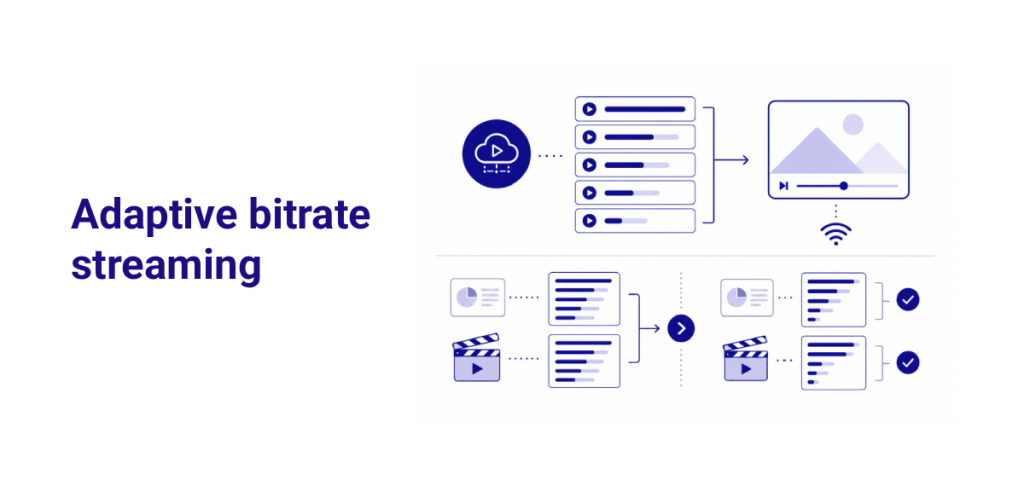
Adaptive bitrate streaming is the baseline. The platform encodes each video at several resolutions and bitrates, and the player switches between them in real time as the viewer’s connection fluctuates. Without it, a learner on a patchy 4G connection either buffers constantly or is stuck with a version too low-quality to read slides. Every serious platform supports this what varies is the quality of the encoding ladder.
Ask about per-title encoding. A generic ladder applies the same bitrate rungs to a static slide-deck lecture and a fast-cut studio production. Per-title encoding analyses each video and tunes the ladder to it, which means less bandwidth consumed for the same perceived quality. On a large library, this is a direct line-item saving and since you’re often paying per GB delivered, it compounds.
CDN coverage determines whether a viewer in a tier-3 town or a different continent gets the same experience as one next to your origin server. Ask which CDNs the platform uses and whether it can fail over between them. Single-CDN dependency is a real availability risk.
4.2 Security and access control
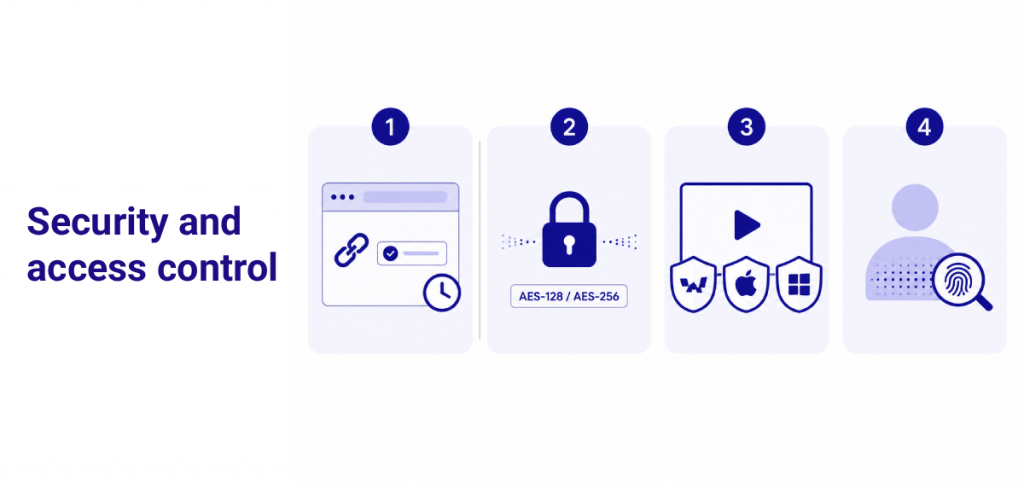
This is where vendor language gets loosest, so it helps to think in rungs. Each rung is meaningfully stronger than the one below, and vendors frequently describe rung one using rung four’s vocabulary.
1: Signed or expiring URLs. The video link stops working after a set window. Stops casual sharing. Does nothing against a determined user with a download tool.
2: (AES-128 / AES-256). The video is encrypted at rest and in transit, and the player fetches a key to decrypt it. Better. But the key exchange isn’t hardware-protected, so a technically capable person can intercept it.
3: Multi-DRM (Widevine, FairPlay, PlayReady). The decryption key is handled inside the device’s secure hardware, not by your player. This is what makes screen-recording blocking possible on most platforms, and it’s what streaming services use. Two questions to press on: does it cover both Widevine (Android, Chrome) and FairPlay (Apple)? And is DRM included, or is it an enterprise-tier upsell that materially changes your quoted price?
4: Forensic watermarking. An overlay carrying the viewer’s ID, email or IP, unique to each playback session. It doesn’t prevent a phone pointed at a screen nothing does but it makes leaked content traceable to an account, which changes behaviour and gives you a basis for enforcement.
4.3 Integration and control
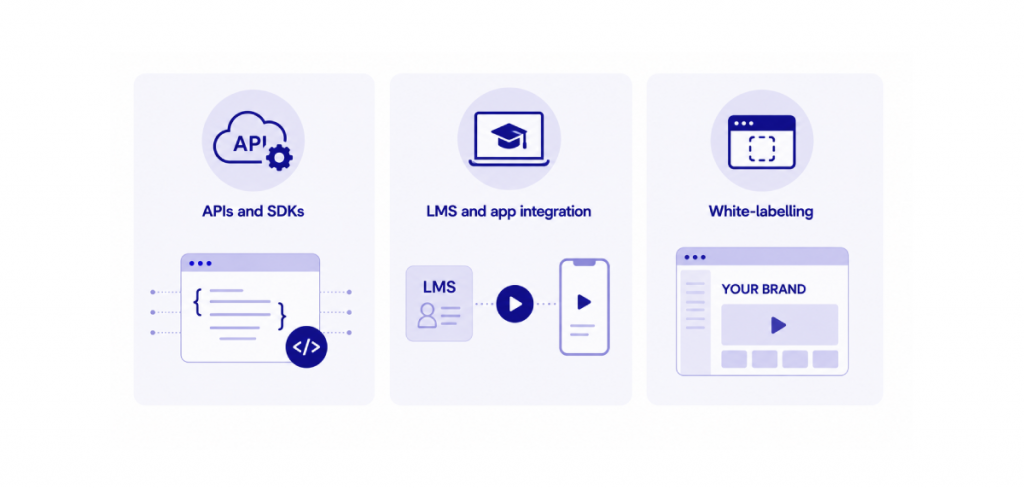
APIs and SDKs. “We have an API” covers a wide range. Read the actual documentation before the sales call it takes twenty minutes and tells you more than the call will. Specifically: can you create assets, upload, generate playback tokens and pull analytics programmatically? Are there webhooks so your system learns that a transcode finished without polling? Which client SDKs exist (Android, iOS, React, Flutter, JavaScript)? A missing SDK for your stack becomes weeks of work.
LMS and app integration. If you run Moodle, Canvas, TalentLMS or your own learning platform, ask specifically how videos are embedded and how access is authorised. The ideal is that your LMS calls the video platform to mint a short-lived, user-specific playback token so access rights live in one system, not two.
White-labelling. At minimum: your logo, your colours, no vendor branding, playback on your domain. For OTT and premium media, ask how far customisation goes chapters, thumbnails, playback speed, custom controls.
4.4 Operations and economics
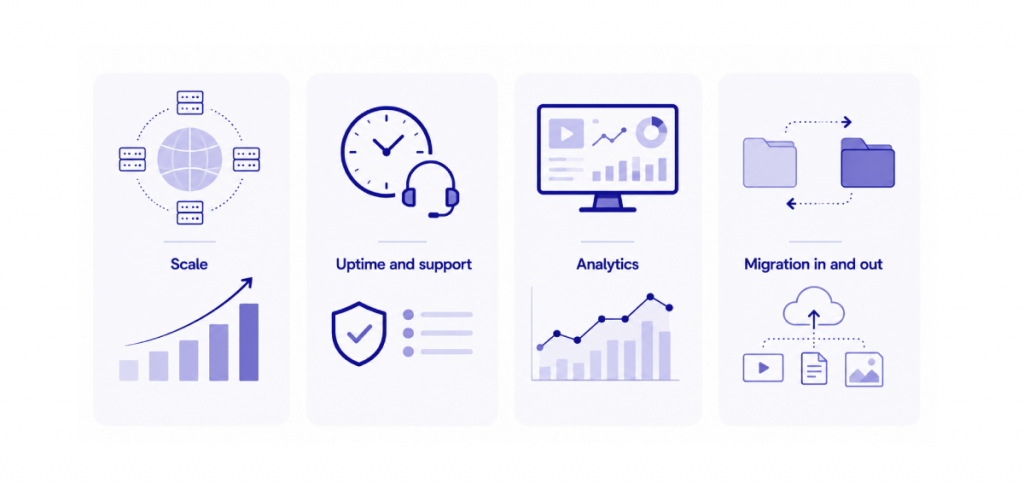
Scale. Separate the two questions: can it store and serve a large library, and can it handle a concurrency spike? Ask for a specific figure peak concurrent viewers on a single live stream and ask what happens the first time you exceed your plan. “Nothing breaks, you’re billed at your overage rate” is a good answer. Throttling or a hard stop mid-event is not.
Uptime and support. An uptime percentage without an SLA is marketing. Ask what the contractual commitment is, what the remedy is when it’s missed, and — the practical question — what happens when a stream fails at 7pm on a Sunday. Email-only support with a next-business-day response is fine for a video library and unworkable for live events. Ask whether you get a named contact or a ticket queue.
Analytics. Play counts are close to useless. What informs decisions: completion rates, drop-off points within each video, device and geography breakdown, and rebuffering data. Drop-off curves tell you which lessons need re-recording. Rebuffering data tells you whether a churn complaint is a content problem or a delivery problem.
Migration in and out. Ask two things. Moving in: will they pull, transcode and package your existing library, and is that transcoding charged? On a large catalogue this is a real number, and some vendors waive it on annual commitments. Moving out: can you export your source files, and what would it cost? A platform that makes leaving expensive has less incentive to keep earning your business.
The same criteria, weighted differently
The five businesses below would all search “best video streaming platform” and need almost entirely different things. Find the row closest to yours.
| Business type | Non-negotiable | Also important | Can usually deprioritise |
| EdTech / paid online courses | Multi-DRM, watermarking, device limits, LMS integration | Mobile SDKs, drop-off analytics, subtitles | Ultra-low latency, ad insertion |
| Coaching institute, live classes | Live concurrency at peak, instant recordings, DVR | Playback on low-bandwidth mobile networks, DRM | Advanced player customisation |
| Corporate L&D | SSO, access control, completion tracking, data residency | Compliance reporting, Zoom/meeting import | Public-facing monetisation, CDN scale |
| Media / OTT | Multi-DRM (studio requirements), CDN reach, smart-TV playback | Ad or subscription support, content catalogue tools | LMS integration |
| SaaS embedding video | Clean APIs, webhooks, SDK for their stack, predictable per-tenant cost | White-label player, upload from their app | Live streaming, DRM (often) |
An EdTech company and a corporate L&D team both “need secure video,” but one is defending revenue against paying customers who might redistribute, and the other is defending confidential material inside a trusted network. Those lead to different products.
Should you build your own video streaming platform, or buy one?
Building is entirely feasible. FFmpeg, a packager like Shaka, a CDN and an open-source player will get you a working pipeline. The question is not capability, it’s whether the ongoing cost is worth it.
| Build in-house | Managed platform | |
| Time to first stream | 3–9 months for production quality | Days |
| Upfront engineering | Transcoding pipeline, packaging, player, DRM integration, CDN config | Integration work only |
| DRM | Commercial licences from Google/Apple/Microsoft plus a licence server, or a third-party vendor | Typically included or bundled |
| Ongoing maintenance | Codec updates, browser and OS playback regressions, scaling, on-call | Vendor’s problem |
| Cost at low volume | Higher (fixed engineering cost, no volume rates) | Lower |
| Cost at very high volume | Can be lower, with committed CDN contracts and a dedicated team | Depends on negotiated rates |
| Control | Total | Bounded by the API |
The practical recommendation. Buy, unless one of two things is true: video delivery is your core product and a differentiator (you’re a streaming company, not a company that streams), or you’re at a volume where you can negotiate wholesale CDN commitments and fund a permanent video infrastructure team. For most EdTech businesses, coaching institutes, corporate L&D teams and SaaS products, a managed platform wins clearly — the engineering months are better spent on the product your customers actually pay for.
A middle path exists and is under-discussed: run your own delivery and buy only the hard parts, typically DRM licensing. Some vendors will sell components separately. Ask.
The video streaming platform evaluation checklist
Print this, or paste it into your vendor comparison sheet.
Content protection
- Which DRM systems are supported — Widevine, FairPlay, PlayReady?
- Is DRM included in the quoted plan or an add-on?
- Is forensic or per-session watermarking available?
- Can playback be restricted by domain, device, IP or concurrent session?
- Is content encrypted at rest and in transit?
- Are audit-grade playback logs available?
Delivery and quality
- Adaptive bitrate streaming with HLS and DASH?
- Per-title encoding, or a fixed ladder?
- Which CDNs, and is there multi-CDN failover?
- Measured playback performance in your key regions?
- Rebuffering and quality-of-experience data exposed?
Live streaming
- RTMP/SRT ingest from standard encoders without custom work?
- Verified peak concurrency on a single stream?
- DVR controls — pause, rewind, replay?
- How quickly are recordings available after the stream ends?
- Can recordings be trimmed and republished as VOD?
Integration
- Public API documentation you can read before buying?
- Webhooks for asset lifecycle events?
- SDKs for your specific stack?
- Documented LMS integration path with per-user token auth?
- SSO support, if required?
- Can a video file be replaced without changing its URL?
Branding
- Full white-label player — logo, colours, no vendor branding?
- Playback on your own domain?
- Configurable player controls, chapters, thumbnails?
Analytics
- Per-video completion and drop-off curves?
- Device, browser and geography breakdown?
- Per-user viewing history where required?
- API access to raw analytics data?
Where TPStreams fits
Having laid out the criteria, here is a straightforward account of how TPStreams maps to them — useful as a concrete reference point whether or not it ends up on your shortlist.
TPStreams is a video hosting and streaming platform used largely by education, certification, corporate training, media and faith-based organisations — contexts where content is directly tied to revenue or regulatory obligation. Against the criteria above:
- Content protection. Multi-DRM covering Google Widevine and Apple FairPlay, with AES-256 encryption at rest and in transit, per-session forensic watermarking that embeds viewer ID, email or IP into playback, token-based authentication and domain locking.
- Live. RTMP ingest from OBS, vMix, Wirecast or hardware encoders, DVR controls, automatic recording available immediately after a stream ends, with in-dashboard trimming and chaptering before publishing as on-demand.
- Integration. REST APIs with JSON responses and webhook support, SDKs for Android, iOS, React, Flutter and JavaScript, documented LMS and CMS embedding, and a Zoom integration that auto-imports recordings with optional DRM applied. Public developer documentation is available before you talk to sales — worth using, per the pilot section above.
- Player and branding. Configurable player with your logo, colours, chapters, thumbnails and playback speed. Videos can be replaced without changing their URLs, so course pages and historical analytics stay intact.
- Accessibility. AI-generated multilingual subtitles and transcripts across a library.
- Analytics. Engagement, completion, drop-off and device breakdown per asset, plus playback, IP and device logs for audit and rights-management purposes.
- Commercial model. Delivery, storage, DRM licences, transcoding, subtitles and live are bundled into a single plan rather than metered separately, with overage billed at the tier rate rather than throttled. Migration transcoding is free on annual plans — which addresses the back-catalogue cost discussed earlier.


